
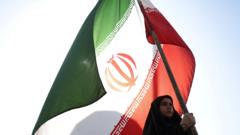
Tehran's Narrative: Victory or Necessity?
The Iranian leadership is actively portraying its nascent memorandum of understanding (MoU) with the United States as a triumph achieved through steadfast resistance, rather than a strategic concession. This argument faces considerable challenges domestically, given the recent conflict, severe economic pressures, and vocal opposition to compromise with Washington from various segments of society, including some within the Islamic Republic's traditional support base.
Furthermore, a faction of Iranians, both inside and outside the country, views the current crisis not as an opportunity for diplomatic resolution but as a potential catalyst for regime change. This fractured political landscape forms the backdrop against which Tehran is attempting to garner support for the agreement.
Official Endorsements and Strategic Framing
Senior Iranian officials have presented the deal as a significant achievement. Mohammad Bagher Qalibaf, the Speaker of Parliament and a key figure in the negotiations, declared that Iran had taken "a long step towards final victory." President Masoud Pezeshkian has also emphasized the potentially transformative nature of the understanding, suggesting that its full implementation could resolve numerous national issues and usher in "a different world" for Iran and the broader Middle East.
Qalibaf's public support is particularly noteworthy, as he is not typically aligned with Pezeshkian's more moderate political faction. His endorsement indicates broader backing for the deal from influential elements within the Iranian system, including parts of the Islamic Revolutionary Guard Corps.
The leadership's framing of the agreement as a victory is underpinned by the argument that the United States and Israel failed to achieve their primary objectives. According to Tehran, these objectives included compelling Iran's surrender, overthrowing the Islamic Republic, ending Iran's nuclear program through military intervention, or severing its ties with Hezbollah. Instead, Iran remains engaged in negotiations, with Lebanon included in the framework and discussions around sanctions relief ongoing.
Internal Dissent and Economic Realities
Despite the official narrative, the deal faces internal criticism. A hard-line Member of Parliament, who serves as the deputy chair of the National Security Committee, reportedly characterized the draft agreement as a document that could reduce Iran to an "American colony." He also accused negotiators of disregarding the Supreme Leader's directive to keep the Strait of Hormuz closed to shipping. Such criticism, emanating from within a national security oversight institution, carries significant weight.
For months, hard-line voices in parliament, state-affiliated media, and pro-government gatherings have consistently expressed distrust of the United States. They often cite the timing of diplomatic efforts shortly before the recent conflict, suggesting that the Trump administration used negotiations as a pretext while Israel and the US prepared military action. For these critics, any agreement with Washington risks appearing as appeasement.
However, some of these critical voices have recently become less prominent, potentially signaling authorization for the deal from the highest levels of the state. While this does not imply complete unity, it suggests that the leadership may have concluded that the costs of rejecting the agreement outweigh the potential backlash from hard-liners.
Economic pressure is a central factor in this calculation. While Iran's leadership may attribute the agreement to its military leverage, including actions around the Strait of Hormuz and attacks on regional energy interests, the country's economy has also played a decisive role. The recent conflict, sanctions, shipping restrictions, reduced access to oil markets and hard currency, and high inflation have severely impacted both the nation and ordinary citizens. For many Iranian families, the critical question is not whether the agreement signifies victory, but whether it will alleviate economic hardship and reduce the threat of further conflict.
US Vice-President JD Vance has clarified that Iran will not receive American taxpayer money but could access billions of dollars if it fulfills its commitments and sanctions are eased. This allows Tehran to present the deal as a pathway to investment and reconstruction, rather than dependence on the United States.
Uncertainties and Regional Dynamics
Significant risks remain, as the full details of the memorandum have not been publicly disclosed, and further negotiations are anticipated. Key contentious issues, including the future of Iran's enriched uranium, permissible enrichment levels, verification protocols, sanctions relief, the status of Hormuz, and the situation in Lebanon, are yet to be fully resolved.
Uncertainty also surrounds Israel's role. Prime Minister Benjamin Netanyahu has refuted claims of an Israeli withdrawal from southern Lebanon, asserting that Israeli forces will remain there as long as necessary. Concurrently, Donald Trump has publicly criticized Israel's conduct in Lebanon, citing excessive casualties and expressing dissatisfaction with an Israeli strike on Beirut shortly before the Iran-US deal, despite affirming his strong relationship with Netanyahu.
For Tehran, this apparent friction between Washington and Israel serves a strategic purpose, allowing it to claim that Iranian pressure has constrained Israel's operational freedom. However, this dynamic also renders the deal fragile. Continued Israeli operations in Lebanon could pressure Iran to retaliate, and if Washington proves unable to restrain Israel, Tehran's assertion that Lebanon is covered by the memorandum could be swiftly tested.
Public reaction from BBC Persian's audience indicates a mixed reception to the official victory narrative. Some expressed persistent distrust and concerns about future governance, even while acknowledging relief over a potential reduction in conflict. Others questioned the tangible benefits of US military action if it did not lead to political change, highlighting ongoing misery and economic damage. Conversely, some viewers were more supportive, viewing Iran as the victor who achieved sanctions relief through strength, or cautiously welcoming the agreement as a temporary respite allowing for a return to normalcy. This latter perspective, emphasizing a much-needed period of calm, may represent the most pragmatic interpretation of the current situation.
Ultimately, while the Islamic Republic endeavors to frame the deal as a victory, for many Iranians, its true success will be measured by tangible improvements: an end to conflict, easing prices, the arrival of sanctions relief, and the leadership's ability to navigate the next phase without renewed escalation.
Source: Tehran selling deal with US as victory – but for Iranians it was necessity